
Overview
Extreme droughts are becoming more frequent. During drought, water deficit suppresses plant growth and shifts community composition; it also alters soil microbial activity and the exchange of resources between plants and mycorrhizal fungi, with knock-on effects on nutrient cycling and carbon storage. After rain returns, these effects often persist as drought legacies that slow ecosystem recovery.
Do grasslands differ in their resistance to drought and their capacity to recover? How do plants above ground and microbes below ground respond together? Answering these questions requires comparing many grasslands under one common design. The platform was launched in 2018 with a standardised drought experiment at seven sites spanning China’s climate zones and grassland types. Our group joined in 2025, focusing on roots, arbuscular mycorrhizal (AM) fungal hyphae and soil microbes to understand how water and nutrient limitation shape belowground symbioses and the ecosystem carbon cycle.
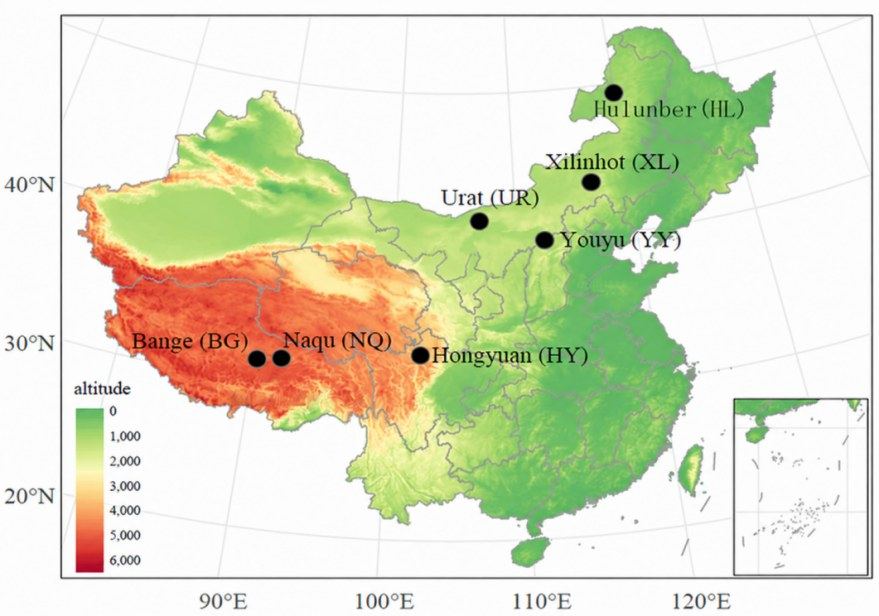
Experimental design
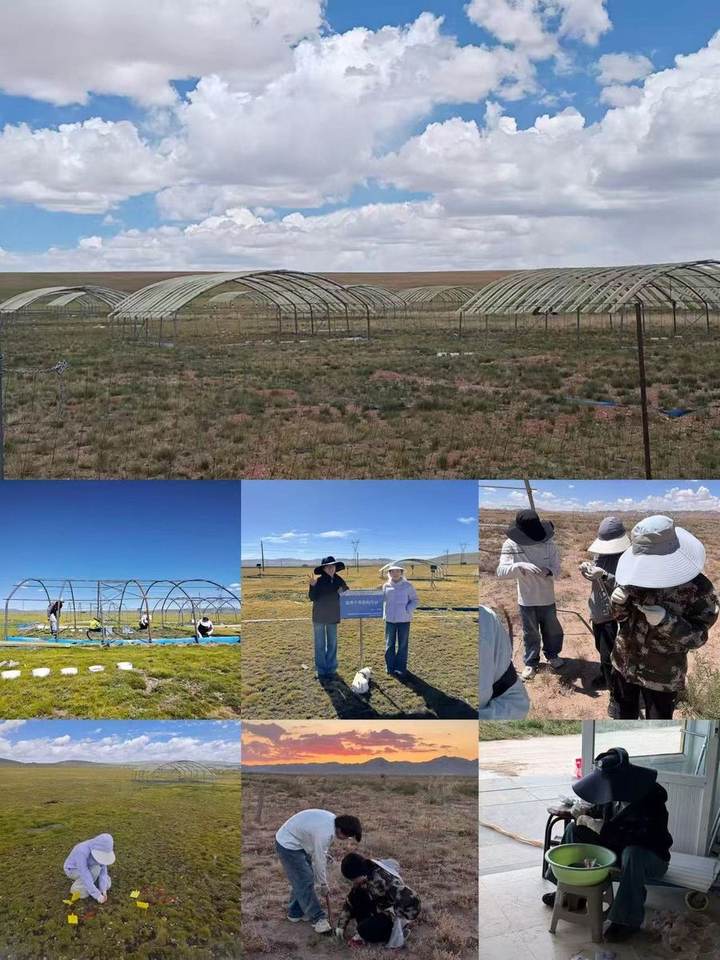
- Randomised block design at each site with two treatments — ambient rainfall (control) and drought (–50% rainfall) — six replicates each, 6 m × 6 m plots.
- Drought intensity was set from each site’s rainfall record to match an extreme dry year (below the 10th percentile) and was imposed for eight consecutive years (2018–2025).
- Rainfall is intercepted by clear, UV-transparent rain-out shelters, and ~1 m deep belowground barriers limit lateral water movement.
- In 2026 the shelters were removed to start a 2–3-year recovery phase, comparing how different grasslands recover after long-term drought.
| Site | Lon (°E) | Lat (°N) | Elevation (m) | MAP (mm) | MAT (°C) | Annual ET (mm) | Aridity index |
|---|---|---|---|---|---|---|---|
| Hulunbuir | 119.95 | 49.33 | 674 | 345.1 | -1.46 | 155.3 | 0.55 |
| Xilinhot | 116.74 | 43.55 | 1263 | 331.3 | 1.61 | 135.8 | 0.59 |
| Youyu | 112.32 | 39.99 | 1348 | 391.7 | 5.54 | 152.8 | 0.61 |
| Urat | 106.97 | 41.42 | 1658 | 162.0 | 5.6 | 29.2 | 0.82 |
| Hongyuan | 102.34 | 32.49 | 3490 | 724.4 | 2.31 | 644.7 | 0.11 |
| Naqu | 92.01 | 31.64 | 4602 | 460.9 | -1.1 | 290.4 | 0.37 |
| Baingoin | 90.23 | 31.38 | 4590 | 459.8 | 0.29 | 271.3 | 0.41 |
Table 1. Climate of the network sites (MAP, mean annual precipitation; MAT, mean annual temperature)
What we measure
Every growing season the network surveys plant communities (species composition, height, density, biomass and litter) and measures plant carbon, nitrogen and phosphorus, together with soil physicochemical properties and soil C, N and P.
Our group adds in-growth cores and hyphal mesh bags that separate the growth and resource uptake of roots from those of AM fungal hyphae. Combined with hyphal purification, lipidomics and rhizosphere/hyphosphere microbiome analyses, this links plant carbon allocation, the biochemical responses of AM fungi, belowground microbial interactions and soil carbon sequestration.
Research questions
- How do roots and AM fungal hyphae respond to drought and to recovery, and how do they trade off in acquiring and allocating resources?
- How do drought and recovery reshape rhizosphere and hyphosphere microbial communities and the way they are recruited?
- Through changes in root–hyphal resource allocation, how do drought and recovery affect the sources, fractions and persistence of soil organic carbon?
Team
Haiyang Zhang · Jing Wang · Fei Zheng · Xuerong Di · Xingguo Han
Funding
- Overseas Talent Recruitment Program, Ministry of Education of China
- Talent Introduction Program, Hebei University