
Overview
What happens to grassland insects, soil microbes and ecosystem carbon and nitrogen cycling when city nights are no longer dark? Street lamps, decorative lighting and building illumination change the night-time environment of urban green spaces, and with it the daily rhythms, feeding behaviour and species interactions of many organisms. ECO-Light asks how artificial light at night (ALAN) affects above- and belowground interactions and, ultimately, ecosystem functions.
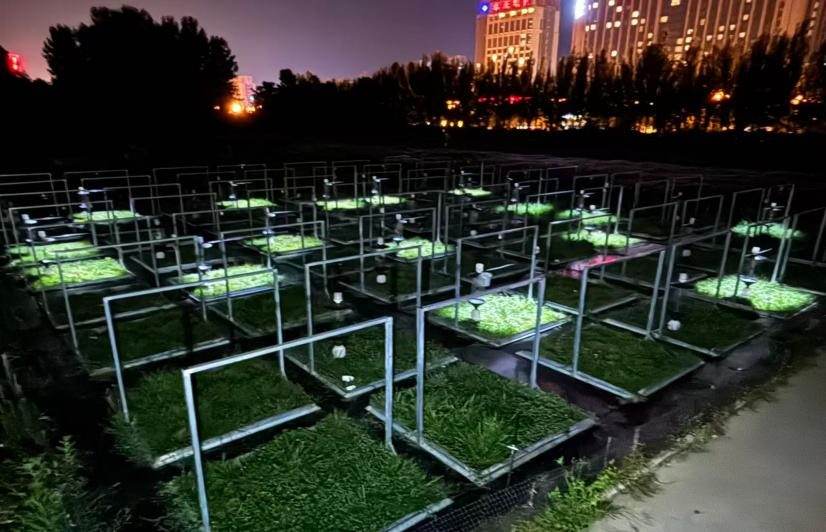
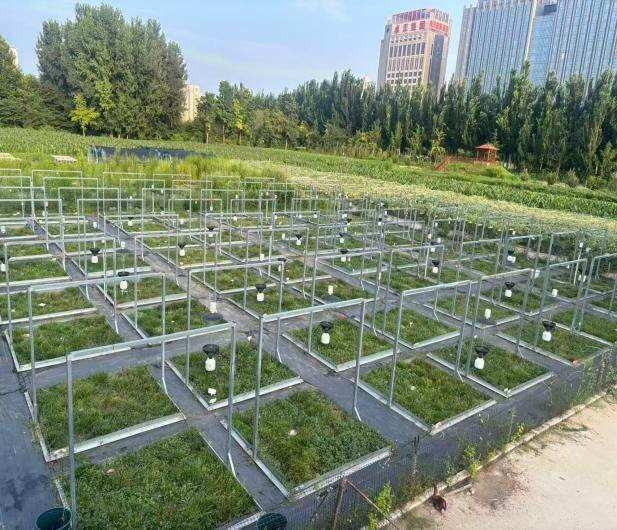
Experimental design
- Built in 2024 on the Qiyi Road campus of Hebei University.
- Randomised block design with two treatments — ALAN and control — 16 replicates each, giving 32 plots of 2 m × 2 m; lamps are mounted on steel frames above the plots.
- Plots are sown with ryegrass and clover, two species widely used in urban lawns and green spaces.
- Carbon-isotope tracing: the top 0–40 cm of soil in every plot was replaced with cropland soil carrying a C4 isotopic signature, while all plants grown are C3. Because C3- and C4-derived carbon differ in δ¹³C, this natural “source label” separates new plant-derived carbon from old soil carbon and lets us follow its input, transformation and turnover over many years.
Monitoring
- Insects — custom-built, rain-proof modular flight-interception traps (clear cross-vanes with collectors above and below) hang from the plot frames, and pitfall traps with rain covers, drainage and escape barriers sample ground-active insects. We analyse insect community composition and plant–insect interactions.
- Soil fauna — bait-lamina strips measure soil-animal feeding activity during the growing season.
- Mycorrhizal fungi — hyphal in-growth bags are installed monthly to track AM fungal carbon supply, hyphal traits and hyphosphere microbes through the season.
- Carbon and nitrogen fluxes — respiration collars, chamber bases and isotope-labelling areas are used to measure net ecosystem CO₂ exchange, ecosystem and soil respiration and greenhouse-gas fluxes, tracing how carbon and nitrogen move among plants, soil and microbes.
Research questions
- Above ground, how does light at night change insect community composition and the interactions between insects and plants?
- In the rhizosphere, how do mycorrhizal fungi and microbial communities respond to light at night? Are the responses transient or lasting, how do they vary in time and space, and how do they affect plant carbon supply belowground?
- Below ground, how do soil animals and microbes interact, and how do these interactions regulate soil carbon and nitrogen cycling?
- At the ecosystem scale, how does light at night ultimately affect carbon uptake and nitrogen cycling?
ECO-Light provides a long-term, controlled and multi-dimensional field experiment for ecology in an urbanising world. Our aim is to follow the chain of effects set off by night-time lighting — from the beat of an insect’s wings to the growth of fungal hyphae, all the way to the fate of each carbon atom in the soil.
Team
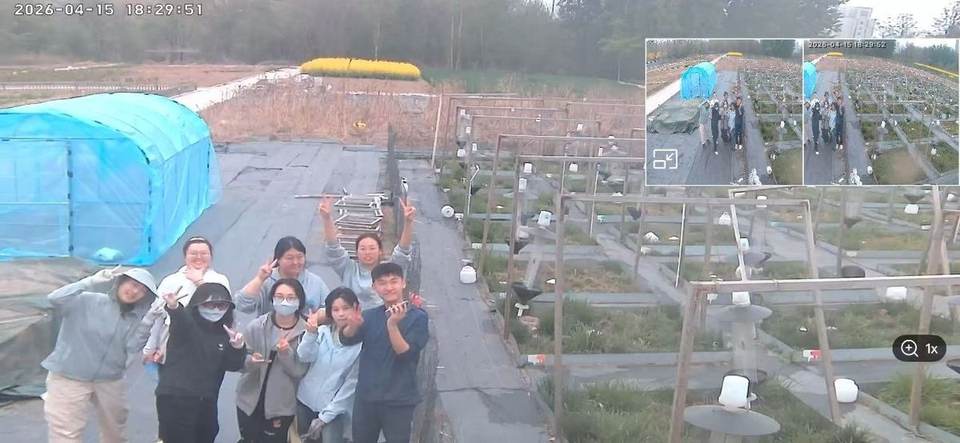
Haiyang Zhang · Jing Wang · Liangchao Jiang · Fei Zheng · Xingguo Han
Funding
- Young Scholars Program, Institute of Life Science and Green Development, Hebei University